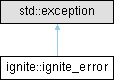
#include <ignite_error.h>
|
| | ignite_error (std::string message) noexcept |
| | ignite_error (std::string message, std::int32_t flags) noexcept |
| | ignite_error (error::code code, std::string message) noexcept |
| | ignite_error (error::code code, std::string message, std::exception_ptr cause) noexcept |
| | ignite_error (error::code code, std::string message, uuid trace_id, std::optional< std::string > java_st) noexcept |
| char const * | what () const noexcept override |
| const std::string & | what_str () const noexcept |
| error::code | get_status_code () const noexcept |
| uuid | get_trace_id () const noexcept |
| const std::optional< std::string > & | get_java_stack_trace () const noexcept |
| std::exception_ptr | get_cause () const noexcept |
| std::int32_t | get_flags () const noexcept |
| template<typename T> |
| void | add_extra (std::string key, T value) |
| template<typename T> |
| std::optional< T > | get_extra (const std::string &key) const noexcept |
◆ ignite_error() [1/5]
| ignite::ignite_error::ignite_error |
( |
std::string | message | ) |
|
|
inlineexplicitnoexcept |
◆ ignite_error() [2/5]
| ignite::ignite_error::ignite_error |
( |
std::string | message, |
|
|
std::int32_t | flags ) |
|
inlineexplicitnoexcept |
◆ ignite_error() [3/5]
| ignite::ignite_error::ignite_error |
( |
error::code | code, |
|
|
std::string | message ) |
|
inlineexplicitnoexcept |
Constructor.
- Parameters
-
| code | Status code. |
| message | Message. |
◆ ignite_error() [4/5]
| ignite::ignite_error::ignite_error |
( |
error::code | code, |
|
|
std::string | message, |
|
|
std::exception_ptr | cause ) |
|
inlineexplicitnoexcept |
Constructor.
- Parameters
-
| code | Status code. |
| message | Message. |
| cause | Error cause. |
◆ ignite_error() [5/5]
| ignite::ignite_error::ignite_error |
( |
error::code | code, |
|
|
std::string | message, |
|
|
uuid | trace_id, |
|
|
std::optional< std::string > | java_st ) |
|
inlineexplicitnoexcept |
Constructor.
- Parameters
-
| code | Status code. |
| message | Message. |
| trace_id | Trace ID. |
| java_st | Java stack trace. |
◆ add_extra()
template<typename T>
| void ignite::ignite_error::add_extra |
( |
std::string | key, |
|
|
T | value ) |
|
inline |
Add extra information.
- Template Parameters
-
- Parameters
-
◆ get_cause()
| std::exception_ptr ignite::ignite_error::get_cause |
( |
| ) |
const |
|
inlinenodiscardnoexcept |
Get error cause.
- Returns
- Error cause. Can be empty.
◆ get_extra()
template<typename T>
| std::optional< T > ignite::ignite_error::get_extra |
( |
const std::string & | key | ) |
const |
|
inlinenodiscardnoexcept |
Get extra information by the key.
- Returns
- Extra.
◆ get_flags()
| std::int32_t ignite::ignite_error::get_flags |
( |
| ) |
const |
|
inlinenodiscardnoexcept |
Get flags. Internal method.
- Returns
- Flags.
◆ get_java_stack_trace()
| const std::optional< std::string > & ignite::ignite_error::get_java_stack_trace |
( |
| ) |
const |
|
inlinenodiscardnoexcept |
Get Java side stack trace. Can be empty if the error generated on the client side or if the server side option for sending stack traces to the client is disabled.
- Returns
- Java side stack trace.
◆ get_status_code()
| error::code ignite::ignite_error::get_status_code |
( |
| ) |
const |
|
inlinenodiscardnoexcept |
Get status code.
- Returns
- Status code.
◆ get_trace_id()
| uuid ignite::ignite_error::get_trace_id |
( |
| ) |
const |
|
inlinenodiscardnoexcept |
Get trace ID. Trace ID can be used to track the same error in different part of product and different logs (e.g., server and client)
- Returns
- Trace ID.
◆ what()
| char const * ignite::ignite_error::what |
( |
| ) |
const |
|
inlinenodiscardoverridenoexcept |
◆ what_str()
| const std::string & ignite::ignite_error::what_str |
( |
| ) |
const |
|
inlinenodiscardnoexcept |
Get the error message as std::string.
The documentation for this class was generated from the following file:

 1.14.0